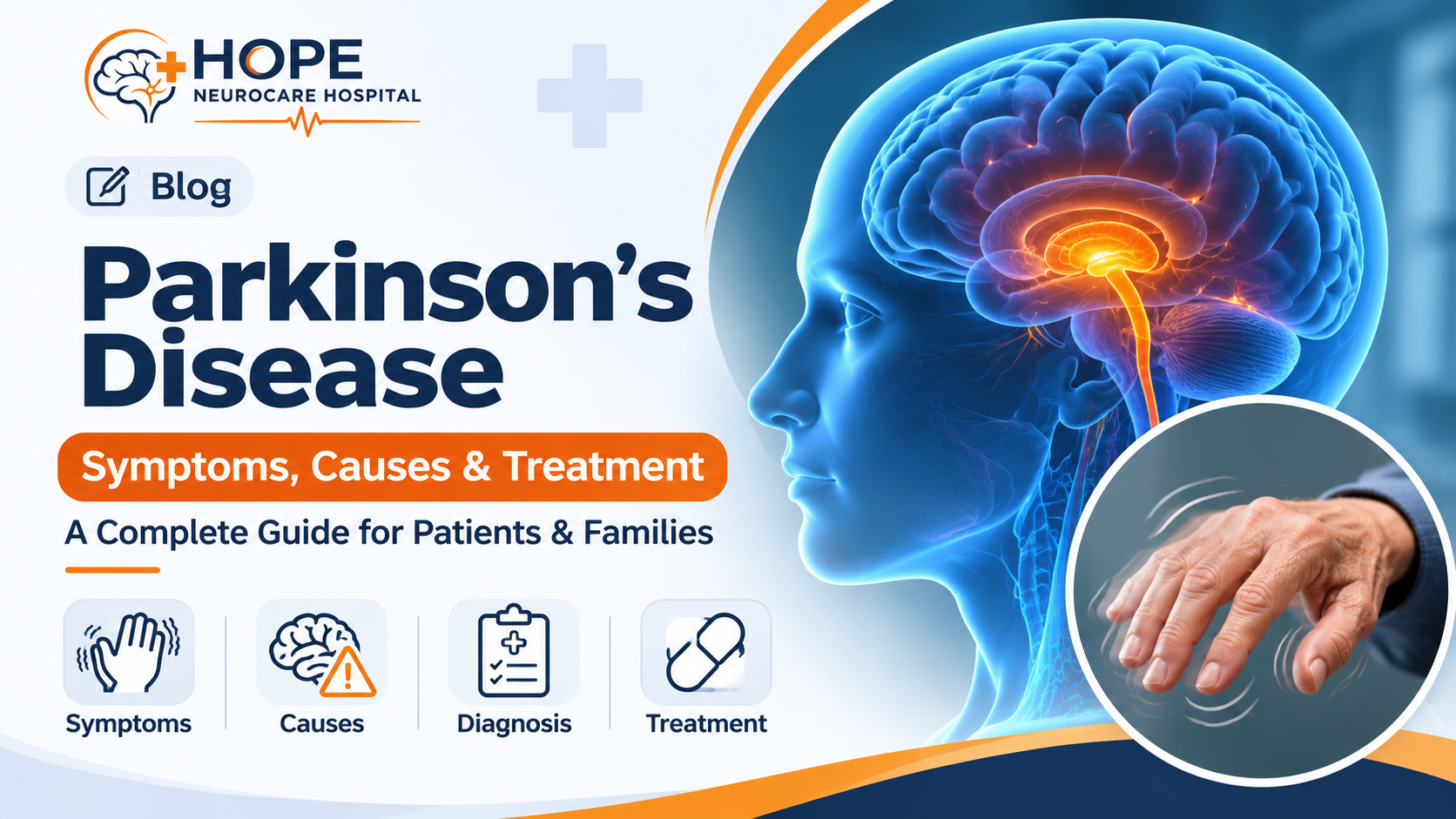
Parkinson’s disease is a progressive neurological condition that affects movement. It develops when certain brain cells responsible for producing dopamine become damaged or stop functioning properly. As a result, people may experience tremors, muscle stiffness, slow movements and balance difficulties.
Understanding Parkinson’s disease is important for early evaluation and appropriate care. If you or someone in your family experiences movement-related symptoms, consulting a neurologist can help identify the cause and discuss suitable treatment options.
Parkinson’s disease is a disorder of the nervous system that mainly affects the body’s ability to control movement. It is associated with the loss of dopamine-producing cells in a part of the brain called the substantia nigra.
Dopamine helps coordinate smooth and controlled movements. Therefore, reduced dopamine levels can make everyday activities more difficult.
However, Parkinson’s disease affects people differently. Symptoms and their progression can vary from one person to another.
Parkinson’s disease can cause several motor and non-motor symptoms. These symptoms may develop gradually and become more noticeable over time.
Some people experience shaking in their hands, fingers, legs or jaw. Tremors often begin on one side of the body and may be more noticeable when the affected body part is resting.
Muscle stiffness can make movement uncomfortable. It may affect the arms, legs, shoulders or other body parts.
Bradykinesia refers to slowness of movement. People may take longer to perform everyday activities. Walking, dressing and getting out of a chair can become difficult.
Some people develop posture changes and difficulty maintaining balance. This can increase the risk of falls.
Parkinson’s disease can also affect areas beyond movement. Some people experience sleep disturbances, constipation, reduced sense of smell, mood changes or speech difficulties.
The exact cause of Parkinson’s disease is not fully understood. However, researchers believe that a combination of genetic and environmental factors may contribute to its development.
Age is an important risk factor, although Parkinson’s disease can also affect younger adults.
Having a family history may increase risk in some cases. However, most people diagnosed with Parkinson’s disease do not have a known inherited cause.
There is no single routine test that confirms every case of Parkinson’s disease. Diagnosis is generally based on medical history, symptoms and a neurological examination.
A neurologist may assess movement, muscle stiffness, tremors, walking pattern and balance.
Additionally, the doctor may recommend certain tests or brain imaging to rule out other conditions when needed.
There is currently no treatment that completely cures Parkinson’s disease. However, different treatment approaches can help manage symptoms and support quality of life.
Doctors may prescribe medicines to help manage movement-related symptoms. Levodopa is one commonly used medication. The choice of medicine depends on the patient’s condition and medical history.
Physiotherapy can help improve mobility, flexibility, strength and balance. A personalised exercise programme may support daily activities.
Speech therapy may help people who experience changes in speech or swallowing. Occupational therapy can help patients manage everyday tasks more comfortably.
For selected patients whose symptoms are not adequately controlled with medication, specialists may consider advanced options such as Deep Brain Stimulation (DBS). Suitability depends on detailed medical evaluation.
There is currently no proven method to prevent Parkinson’s disease. However, maintaining general health through regular physical activity, balanced nutrition and adequate sleep can support overall well-being.
People experiencing persistent movement-related symptoms should seek medical evaluation rather than relying on self-diagnosis.
Consider consulting a neurologist if you notice persistent or unexplained symptoms such as:
These symptoms do not always indicate Parkinson’s disease. A proper neurological assessment is important to identify the underlying cause.
Hope NeuroCare Hospital in Ahmedabad provides neurological care and evaluation for patients experiencing different neurological conditions.
If you are concerned about tremors, movement difficulties or other possible symptoms of Parkinson’s disease, consult a qualified neurologist for an appropriate assessment.
The doctor can evaluate your symptoms, discuss suitable investigations and recommend a treatment plan based on your individual needs.
For neurological consultation and appointment enquiries, contact Hope NeuroCare Hospital.
Hospital: Hope NeuroCare Hospital
Address: Near Government Ladies’ Hostel, Gujarat College, Ellis Bridge, Ahmedabad – 380006, Gujarat.
Phone: +91 90990 39570 / +91 90990 39580
Website: https://hopeneurocare.com/
Explore our Home Page or Contact Us page for further information.
There is currently no cure for Parkinson’s disease. However, medicines, rehabilitation and specialist care can help manage symptoms.
No. Some people experience tremors, while others mainly experience stiffness, slow movement or balance difficulties.
Yes. Although it is more common in older adults, Parkinson’s disease can also develop in younger people.
No. Tremors can have several causes. A neurological examination is needed to understand the reason.
Yes. Physiotherapy may help improve mobility, flexibility, strength and balance as part of an individual care plan.
Medical Disclaimer: This article is for general educational purposes only. It does not replace professional medical advice, diagnosis or treatment. Consult a qualified healthcare professional for individual medical concerns.

Hope Neuro Care is dedicated to providing compassionate, advanced, and specialized care for patients dealing with neurological and neurosurgical conditions. Our mission is to offer high-quality treatment.
